 how-to
Search Engine Marketing for Small Business: 2026 Guide
Table of Contents
- What Search Engine Marketing for Small Business Actually Involves
- What You'll Need Before You Start
- Step 1: Do Small Business Keyword Research That Matches Real Searches
- Step 2: Set Up Google Ads for Small Business Without Wasting Budget
- Step 3: Build Local SEO for Small Business So You Show Up in Map Results
- Step 4: SEO vs. PPC for Small Business: How to Split Your Effort
- Common Mistakes That Sink Small Business Search Campaigns
- Conclusion: Run Search Engine Marketing for Small Business as a System
- Frequently Asked Questions
Last Updated: October 12, 2026
What Search Engine Marketing for Small Business Actually Involves
Search engine marketing for small business is the practice of paying for and earning visibility in search results so local customers find you before they find a competitor. It covers two halves: paid ads and organic search. This guide from AI Boom Agency walks through how we build that system for service firms, clinics, gyms, and independent practices.
Here's the part most guides skip. You do not need a big budget or a marketing hire. You need a tight keyword list, one well-built ad campaign, and a Google Business Profile that actually gets managed.
Below, we show you how to set up each piece in order, starting with the research that decides everything else.
What You'll Need Before You Start
Get these five things in place first. Skipping any of them slows the whole campaign down.
- A Google account you control, not a former employee's
- A verified Google Business Profile with your real address or service area
- A simple website with one clear page per service
- A tracking number so you can see which calls came from search
- A monthly budget ceiling you are comfortable spending
That last one matters more than people think. Decide the number before you touch Ads, because the platform is built to spend whatever you allow.
Step 1: Do Small Business Keyword Research That Matches Real Searches
Small business keyword research starts with how customers actually describe their problem, not how you describe your service. A plumber does not sell "drainage solutions." They unclog a kitchen sink at 9pm on a Sunday.
Seed Keywords From Your Service List and Service Area
Write down every service you offer. Then attach your town, suburb, or region to each one. That gives you a starting list.
Examples for a local firm:
- emergency electrician [your town]
- boiler repair near me
- same day locksmith [your suburb]
Sort Keywords by Purchase Intent, Not Search Volume
A keyword with 50 searches a month and clear buying intent beats one with 5,000 searches and no intent. Every time.
Sort your list into three buckets:
| Intent Level | Example Phrase | Action |
|---|---|---|
| Ready to buy | "emergency plumber near me" | Bid on this first |
| Comparing options | "best HVAC company [town]" | Bid second, lower budget |
| Still researching | "how often to service a boiler" | Target with content, not ads |
Most small firms waste money bidding on the third bucket. Those searches rarely convert into a booked job.
Step 2: Set Up Google Ads for Small Business Without Wasting Budget
Google Ads for small business works best with one campaign, one goal, and a tight geographic radius. Do not build five campaigns on day one.
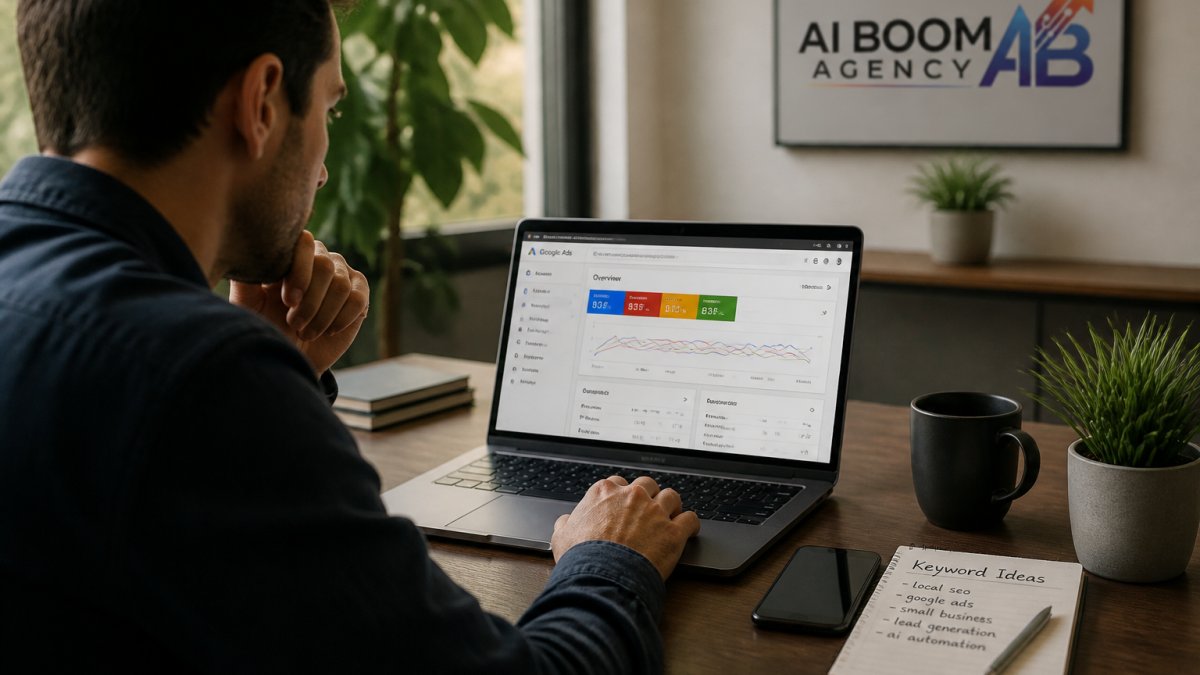
Follow this order:
- Choose "Leads" as your campaign goal
- Set your radius to the area you actually serve
- Add your top 10 to 15 buy-intent keywords only
- Turn off search partners and display expansion
- Write two ads per group and let them run two weeks
- Add negative keywords weekly as junk searches appear
That last step is where most accounts leak money. Check the search terms report every week.
Step 3: Build Local SEO for Small Business So You Show Up in Map Results
Local SEO for small business is what puts you in the map pack, the three-business block above the regular results. That spot often matters more than any ad.
Start with your Google Business Profile. Fill in every field, add real photos, and post updates. Then collect reviews steadily, not in one burst. Ask every happy customer the same day you finish the job.
The basics that move the needle:
Book your free AI audit today →
- Keep your name, address, and phone identical everywhere online
- Add your main service categories, not just one
- Answer every review, good or bad
- List your hours, including after-hours options
Google's own guidance on local search ranking factors confirms that relevance, distance, and prominence drive map results. You control two of those three.
Step 4: SEO vs. PPC for Small Business: How to Split Your Effort
SEO vs. PPC for small business is not a choice between them. It is a question of timing. PPC buys you leads today. SEO builds a lead source that keeps paying without ad spend.
| Situation | Lean Toward | Why |
|---|---|---|
| Brand new, no traffic | PPC 70% / SEO 30% | You need leads now |
| Established, steady cash flow | PPC 40% / SEO 60% | Reduce long-term ad cost |
| Tight budget under a few hundred a month | SEO 80% / PPC 20% | Ads drain fast at low budgets |
| Highly competitive city | PPC 60% / SEO 40% | Organic takes longer to rank |
The mistake is going all-in on one side. Ads stop the moment you stop paying. Organic search takes months to build but then holds.
Common Mistakes That Sink Small Business Search Campaigns
The same four errors show up again and again. Each one is fixable.
Chasing broad keywords. "Plumber" costs a fortune and converts poorly. "Emergency plumber [your town]" costs less and books jobs.
Ignoring the phone. If calls go to voicemail after hours, you paid for a lead you never answered. This is where an AI voice agent earns its keep, answering and booking while you sleep.
Never checking search terms. Without weekly review, your budget drifts toward searches you never wanted.
Treating the website as an afterthought. A slow, outdated site kills conversions no matter how good the ad is. According to Google's page experience guidance, load speed and mobile usability directly affect how visitors behave.
Fix the phone and the site first. Ads amplify whatever you already have, good or bad.
Conclusion: Run Search Engine Marketing for Small Business as a System
Search engine marketing for small business only works when the pieces connect. Research feeds the ads. The ads feed the phone. The phone feeds reviews. Reviews feed the map pack. Break one link and the whole chain slows down.
That is exactly the system AI Boom Agency builds for small firms. Our AI-powered websites load fast and convert visitors. Our voice agents answer every call, day or night, and book appointments without a receptionist. Our chatbots handle the routine questions so your team handles the real work. And our SEO services keep the organic side growing while the ads run.
Book your free AI audit today and see where your search system is leaking leads.
Frequently Asked Questions
What is search engine marketing for a small business?
Search engine marketing is the work of getting your business in front of people who are already searching for what you sell. For a small business, that means two channels working together: paid search such as Google Ads, and organic visibility from local SEO and keyword-focused website pages. The goal is not traffic for its own sake. It is calls, form fills, and booked appointments from people in your service area who need help now.
Is SEO or paid search better for a small business?
SEO vs. PPC for small business is not a winner-takes-all choice. Paid search produces leads within days and lets you test which keywords convert, while local SEO for small business builds a steady stream of calls that does not stop when you pause spending. A practical split is to run a small Google Ads budget on your highest-intent terms while you build out service pages and your Google Business Profile. Use paid data to decide which organic pages to write first.
How much should a small business spend on search engine marketing?
There is no universal number. Spend depends on how competitive your service area is, what a new customer is worth to you, and how many leads you can handle. A safer approach is to set a monthly test budget, track cost per lead, and scale only when the numbers work. Pricing for managed search and automation services depends on scope, so check AI Boom Agency's website for current options or request a quote.
How long does search engine marketing take to work?
Google Ads for small business can produce calls within the first week or two once conversion tracking is set up correctly. Organic results take longer: new service pages and Google Business Profile improvements often need a few months before they rank consistently, and local SEO for small business compounds as reviews and citations build up. Plan for paid search to cover the early gap while organic visibility grows.